What is a Section 179 Tax Deduction?
Section 179 is a provision in the tax code allowing businesses to take a deduction for the full cost of qualifying purchases, such as new equipment and technology, in the year purchased and placed into service.

Before Section 179 was introduced in 1958, business owners had to treat these large expenditures like most other business expenses and depreciate over time. This often made large yet essential purchases impossible for small businesses.
While Section 179 can benefit large businesses as well, its primary purpose is to support small businesses, incentivizing higher-cost equipment and technology purchases today versus waiting, while also stimulating the American economy.
How Does Section 179 Work?
Section 179 is fairly straightforward. Essentially, you purchase, deduct, and save.
For an eligible 2023 tax deduction, purchase your new dental equipment, office equipment, or other business technology and put it into use before December 31, 2023. Assets must be used at least 50% of the time for business.
To calculate the deduction amount, multiply the expense by the percentage used for business — between 50% and 100%.
For the 2023 tax year, up to $1,160,000 of eligible equipment and technology costs can be expensed under Section 179 with a spending cap of $2,890,000. Any expenses over this amount reduce the dollar-for-dollar deduction amount.
When businesses reach $4,050,000 of spending, they zero out and no longer qualify for this deduction, truly making Section 179 a perk for small businesses.
What Purchases Qualify for a Section 179 Deduction?
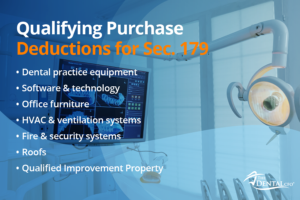
Qualifying purchases for dental practices include, but are not limited to:
- Dental practice equipment, like chairs and X-ray machines
- Software and technology, such as servers, computers, accounting, and dental software
- Office furniture
- Heating/AC systems
- Air ventilation systems
- Fire and alarm systems
- Security systems
- Roofs
- Qualified Improvement Property
- This is any improvement to the interior portion of a building that is non-residential real property. The code section specifically excludes the following items: (1) any improvement attributable to the enlargement of the building, (2) any elevator or escalator, and (3) the internal structural framework of the building.
See the IRS guidelines for a comprehensive list of qualifying purchases.
Does Equipment Need to Be Completely New to Qualify?
All eligible equipment and technology purchases can be brand new or pre-owned, provided it is new to your practice.
Is There a Difference Between Cash and Financed Purchases?
Paying for equipment in cash is the simplest way to claim a Section 179 deduction. Cash-out 100% matches the claimed deduction. You have paid for the equipment in full, and you get the deduction in full.
If you paid for the equipment with a credit card and paid off the balance in the same year, this is also easier to track.
However, it becomes more complicated if you need to finance your purchase with a multi-year loan or special financing from the equipment provider. It places a liability on the books that you’re paying over time.
All principal payments on these liabilities are non-deductible. If you’ve got a 5-year or 7-year loan, we may not recommend a 179 deduction. We may prefer regular depreciation so that your deduction matches the cash payments going out for the loan.
What Is the Difference Between Section 179 and Bonus Depreciation?
As described above, Section 179 is the tax deduction businesses can take when they purchase and place qualifying purchases (such as new equipment or technology) into service in the same year. However, Section 179 does have some limitations.
- The deduction amount is reduced after hitting the year’s spending cap, $2,890,000 in 2023. Any eligible purchases over this amount need to be depreciated according to their asset class.
- You can’t expense these large purchases if your company operates at a net loss.
These limitations can be mitigated with bonus depreciation, sometimes referred to as the additional first-year depreciation deduction. The amount offered — and if it’s offered — varies by tax year.
In 2023, the bonus depreciation is set at 80%. Bonus depreciation can be used in addition to the Section 179 deduction for businesses that purchase equipment valued over the Section 179 equipment purchase limit of $2,890,000 in 2023.
With no spending cap, bonus depreciation is especially advantageous for larger businesses with greater spending thresholds. Additionally, the bonus depreciation can be applied even if your company operates at a net loss in 2023.
How Can You Claim a Section 179 Tax Deduction for Your Dental Practice?
After determining if a Section 179 deduction is right for you, you should work with your tax advisor to calculate your deduction amount.
Using the proper forms from the IRS, you’ll simply select the dollar amount of equipment under Section 179. You’ll include the form in your tax return when you file. You should always consult with a qualified professional tax advisor to determine your eligibility for a Section 179 tax deduction.
.png?width=700&height=467&name=unnamed%20(4).png)
The best time to purchase used dental equipment is right now, as many practices are likely selling off older equipment and upgrading to take advantage of tax incentives. As long as you put the equipment into service by the end of the day on December 31, 2023, you are eligible to receive the Section 179 tax deduction.
Contact Your Tax Advisor to Formulate Your Strategy
Section 179 is a highly beneficial tax planning strategy with significant implications.
At The Dental CFO, we often won’t make a decision about whether or not to use Section 179 for our clients until the very end of the year. We need to see what the practice’s full financial picture looks like. For instance, does the practice owner want to take a big bonus at the end of the year? This would reduce the taxable income and remove the wiggle room we would have had for Section 179.
Contact The Dental CFO to see if Section 179 deductions are right for you this year and to formulate your overall tax strategy.